In my office, an entire bookcase is dedicated to books on writing. While you can’t learn writing just by reading a book about it, there are books that can help you plot your novel, create believable characters, revise your manuscript, and improve your writing skills.
Since there are so many books on how to write a novel out there, it’s hard to know which ones to read. Maybe my list of personal favorites will help.
Books about writing in general
- Self-Editing for Fiction Writers by Renni Browne & Dave King: Despite the title, this book doesn’t cover just self-editing; it covers all aspects of writing. I really recommend it for a basic understanding of concepts such as show and tell, point of view, and dialogue mechanics.
- Stein on Writing by Sol Stein: Sol Stein’s books is a classic—and for a good reason. Stein was a well-respected editor and novelist. His book addresses both writing fiction and writing nonfiction and includes a great chapter on writing dialogue.
- On Writing by Stephen King: This is both a memoir and a book on writing. Read it even if you are not a fan of Stephen King.
Books on creating believable characters and point of view
- Characters, Emotion & Viewpoint by Nancy Kress: This is a part of the Writers’ Digest Elements of Fiction series that also includes other excellent books. It covers developing three-dimensional characters and also point of view.
Books on plot and plotting
- Plot & Structure by James Scott Bell: James Scott Bell explains story structure and how to develop strong openings, middles, and ends.
- Rock Your Plot: A Simple System for Plotting Your Novel by Cathy Yardley: Ms. Yardly’s book will help you plot the turning points of your novel, create a scene-by-scene outline, and get to know your characters better.
- Outlining Your Novel: Map Your Way to Success by K.M. Weiland: This to-the-point book explains the benefits of outlining and gives you pointers on how to brainstorm and outline your novel.
Books on Grammar, spelling, and style
- Woe Is I by Patricia T. O’Conner: Well written and fun. Who knew there was such a thing as grammar book that makes you laugh!
- Merriam-Webster’s Collegiate Dictionary (11th edition): This is the dictionary I use. There’s also an online version.
- The Synonym Finder by J.I. Rodale: This very expansive volume will help you out whenever you’re in need of a synonym.
- The Chicago Manual of Style (16th edition): The style guide that most companies publishing fiction use. Make sure you (and your editor) are familiar with it.
My own books on writing
- Show, Don’t Tell: How to write vivid descriptions, handle backstory, and describe your characters’ emotions
- Point of View: How to use the different POV types, avoid head-hopping, and choose the best point of view for your book
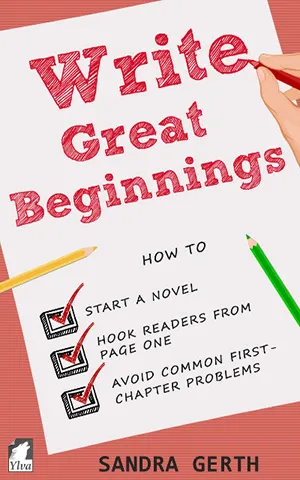
- Write Great Beginnings: How to start a novel, hook readers from page one, and avoid common first-chapter problems
- Time Management for Writers: How to write faster, find the time to write your book, and be a more prolific writer
- Goal Setting for Writers: How to set and achieve your writing goals, finally write a book, and become a successful author
There are many more helpful books on writing, but these are the ones I use most often.
If you can recommend other helpful books on writing, please leave a comment.
4 Responses
Thank you for the list Sandra!
I think “On becoming a novelist” by John Gardner is a superb book for a novice writer. It covers in details the “how” of writing (in Gardner’s words creating a “vivid and continuous dream” that your readers can later share) and becoming a writer (the qualities that are indispensable or important in a young novelist). His love for both writing and the language and the painstaking care with which every sentence is crafted are visible on every page.
His book is also mentioned on the first page of “Self-editing for fiction writers” which you listed first.
Hope that helps!
Thank you! John Gardner’s book is on my bookshelf too.
Great! I tried to spot it but couldn’t see on the picture. Have you read his other books – The Art of Fiction and On Moral Fiction?
I have read “The Art of Fiction” but not (yet) “On Moral Fiction.”